
Agricultural land is one of the most important assets in commercial farming. However, owning or leasing productive land does not automatically guarantee good harvests or sustainable returns. Soil degradation, declining fertility, water shortages and poor land management can gradually reduce a farm’s productive capacity.
This is where regenerative farming becomes important.
Regenerative farming is an approach that focuses on improving soil health, conserving natural resources and strengthening the long-term productivity of agricultural land. For Kenyan farmers and agricultural investors, it offers practical ways to manage production resources while reducing some of the risks associated with conventional farming.
1. WHAT IS REGENERATIVE FARMING?
Regenerative farming is an agricultural approach that aims to restore and improve the natural resources supporting food production, particularly soil, water and biodiversity.
Rather than focusing exclusively on the next harvest, it considers how farming activities affect the productive capacity of the land over several seasons.
Its main principles include:
- Minimising unnecessary soil disturbance.
- Keeping soil covered with vegetation or organic materials.
- Increasing crop diversity.
- Maintaining living roots in the soil.
- Improving organic matter and nutrient cycling.
- Integrating trees and livestock where appropriate.
- Reducing soil erosion and improving water management.
Regenerative farming overlaps with organic farming, conservation agriculture and climate-smart agriculture, but these approaches are not identical. For example, organic farming focuses on approved production inputs and standards, while conservation agriculture emphasises minimum soil disturbance, permanent soil cover and crop diversification.
Regenerative farming takes a broader approach by focusing on measurable improvements in the condition and productive capacity of the farming system.
2. IMPORTANT REGENERATIVE FARMING PRACTICES
Several practical techniques can help farmers implement regenerative agriculture.
- Minimum or reduced tillage
Repeated ploughing can disturb soil structure and expose the soil to erosion. Reducing unnecessary tillage helps preserve soil structure and can protect soil moisture.
However, farmers must plan alternative weed management and ensure that reduced tillage suits their soils and production systems.
- Cover cropping and mulching
Cover crops protect the soil between production cycles, while mulch covers the soil using materials such as crop residues, grass and other suitable organic matter.
These practices reduce direct exposure to sunlight and rainfall impact, helping to conserve moisture and limit erosion.
Leguminous cover crops can also contribute nitrogen to the farming system, depending on the species and management.
- Crop rotation and intercropping
Growing different crops in rotation helps diversify production and can interrupt certain pest and disease cycles.
Intercropping, such as combining maize with suitable legumes, can improve land utilisation and diversify potential harvests.
The crop combinations should be selected carefully to avoid excessive competition for water, sunlight and nutrients.
- Agroforestry
Agroforestry involves integrating suitable trees and shrubs into crop or livestock production systems.
Trees can provide shade, fodder, fuelwood, fruit, wind protection and other useful products. Their roots and leaf litter can also contribute to improved soil conditions.
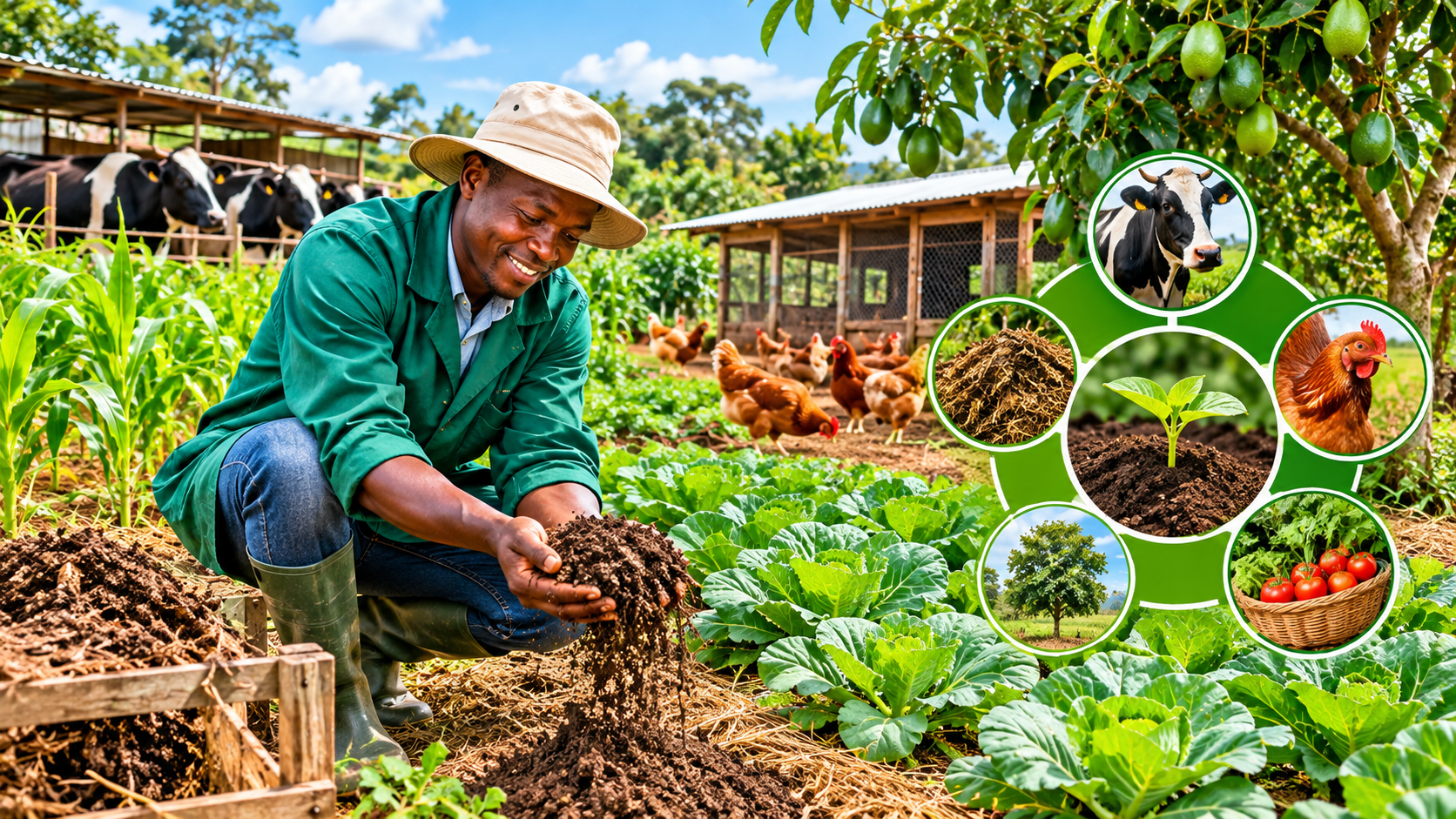
- Composting and organic matter management
Compost and well-managed farmyard manure can improve soil organic matter and contribute nutrients.
Farmers can recycle crop residues and suitable livestock waste rather than treating these materials as unwanted waste.
The quality, maturity and application rates of organic materials matter. Manure should be handled and applied safely to avoid introducing pathogens or contaminating produce.
- Integrated crop and livestock farming
Livestock can contribute manure to crop production, while crop residues and suitable fodder crops can support animal feeding.
This creates opportunities to recycle nutrients and diversify farm income.
However, grazing must be properly managed. Excessive stocking rates and uncontrolled grazing can worsen soil degradation.
3. BENEFITS OF REGENERATIVE FARMING
The benefits depend on the practices adopted and the condition of the farm.
Improved soil health: Increasing organic matter and reducing erosion can support better soil structure, biological activity and nutrient cycling.
Better water management: Mulching, vegetation cover and improved soil structure can encourage water infiltration and help conserve soil moisture.
Reduced soil degradation: Keeping soil covered and reducing unnecessary disturbance can protect farmland from erosion.
Diversified production: Integrating crops, trees and livestock can create additional products and potential income streams.
Potential input savings: Better nutrient recycling and improved soil management may reduce dependence on certain purchased inputs over time.
4. REGENERATIVE FARMING IN KENYA: PRACTICAL APPLICATIONS
Regenerative farming can be adapted to different Kenyan agricultural environments.
In semi-arid counties such as Kajiado, Machakos and Kitui, water conservation should be a priority.
Farmers can consider:
- Mulching to reduce direct soil exposure.
- Rainwater harvesting and appropriate water storage.
- Drought-tolerant cover crops where moisture permits.
- Agroforestry using suitable local tree species.
- Fodder production and controlled grazing.
- Manure application to improve soil organic matter.
In higher-rainfall areas, crop rotation, intercropping, cover cropping, agroforestry and reduced tillage may be particularly useful.
The best combination depends on soil type, rainfall, available water, farm size and the intended agricultural enterprise.
For example, a commercial farmer in Isinya may prioritise drip irrigation, mulching, manure management and drought-tolerant agroforestry rather than adopting water-intensive cover crops.
5. CHALLENGES AND RISKS TO CONSIDER
Regenerative farming is not without challenges.
Organic materials may be difficult to obtain in sufficient quantities. Cover crops may compete with food crops for limited water. Agroforestry requires time, appropriate species and careful spacing.
Farmers may also need additional technical knowledge and labour during the transition.
Poorly managed livestock integration can cause overgrazing, while reducing tillage without an effective weed management strategy can create production challenges.
It is therefore important to introduce practices gradually, monitor results and adjust according to farm conditions.
6. HOW TO START REGENERATIVE FARMING
A practical starting point involves seven steps:
- Assess the land: Conduct soil testing and identify erosion, drainage, fertility and water management challenges.
- Identify priorities: Determ ine whether the main problem is declining fertility, water stress, soil erosion or poor nutrient management.
- Select suitable practices: Choose techniques that match the farm’s climate, soil and production objectives.
- Start small: Test selected practices on a manageable section of land before expanding.
- Manage resources: Plan for water, organic inputs, labour, planting materials and livestock management.
- Keep records: Track input expenditure, yields, sales, labour and soil condition.
- Evaluate and scale: Compare performance over successive production cycles and expand practices that demonstrate measurable value.
Monitoring is essential. Farmers should assess soil organic matter, crop performance, water use and operating costs rather than relying on the regenerative label alone.
CONCLUSION
By improving soil health, conserving water, diversifying production and recycling farm resources, farmers can support more productive and resilient farming systems.
For agricultural investors, the important consideration is long-term land productivity. A productive farm requires more than suitable land. It also requires appropriate management, reliable water, sound agricultural planning and a clear understanding of market opportunities.
Regenerative farming is not an instant solution to every agricultural challenge, but when properly planned and implemented, it can contribute to a stronger foundation for sustainable commercial agriculture.
Looking for agricultural land to start your farming journey?
📞 Reach out for Agricultural Land Lease or Purchase Opportunities +254-725-50 50 50, +254-768-29 23 18
FREQUENTLY ASKED QUESTIONS
1. What is regenerative farming, and how does it work?
Regenerative farming is an approach to agriculture that focuses on improving soil health, conserving water, increasing biodiversity and maintaining long-term land productivity. It uses practices such as mulching, crop rotation, agroforestry, composting and reduced tillage.
2. Is regenerative farming suitable for Kenya’s semi-arid regions?
Yes. Practices such as mulching, rainwater harvesting, agroforestry, manure application and controlled grazing can be useful in semi-arid areas. However, they must be adapted to local rainfall, soil conditions and water availability.
3. What are the most profitable regenerative farming practices?
Profitability depends on the farming enterprise and local conditions. Mulching, manure management, crop diversification, agroforestry and integrated crop-livestock farming can offer commercial benefits through improved resource utilisation, diversified production and potential input savings.
4. Does regenerative farming require significant startup capital?
Not necessarily. Some practices, such as mulching with available crop residues, crop rotation and better manure management, can be introduced with relatively modest investment. Others, including irrigation infrastructure, agroforestry establishment and composting facilities, may require additional capital.
5. How long does it take to see results from regenerative farming?
Some benefits, such as improved soil cover and reduced erosion, can become noticeable within a growing season. Improvements in soil organic matter, soil structure and long-term productivity generally require consistent management over multiple seasons. Results vary according to local conditions.