
INTRODUCTION.
Could your farm generate income from several complementary enterprises while making better use of available resources? Integrated farming offers one approach worth considering, particularly for Kenyan farmers and agribusiness investors looking to improve farm efficiency and diversify production.
However, combining crops, livestock, poultry, or other agricultural activities does not automatically make a farm profitable. Success depends on choosing suitable enterprises, understanding their costs, establishing reliable markets, and managing the farm as one connected business.
1. WHAT IS INTEGRATED FARMING?
Integrated farming is an agricultural system in which two or more farming enterprises are deliberately linked so that the resources, outputs, or by-products of one can support another.
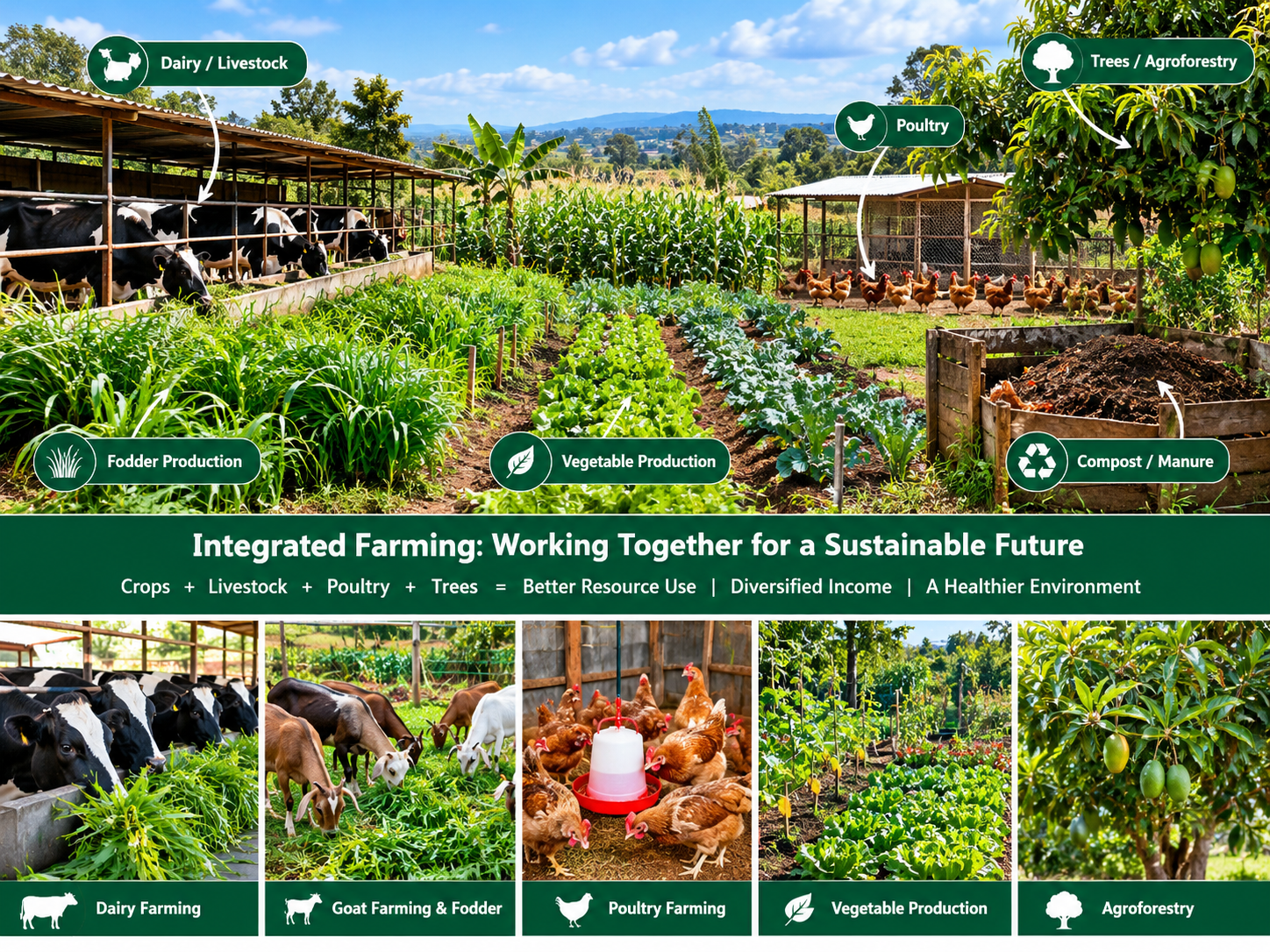
For example, a farmer may grow fodder for goats, collect their manure for composting, and use the compost to improve soil fertility in a vegetable garden. The farmer may then earn income from both livestock and vegetables.
Integrated systems can improve resource use by recycling useful materials between farming activities. However, their interconnected nature also makes management more complex.
2. INTEGRATED FARMING VS CROP DIVERSIFICATION.
These approaches are related, but they are not identical.
Crop diversification involves growing different crops to spread production and market risks. Integrated farming goes further by connecting enterprises through resource sharing and planned production relationships.
For instance, growing onions, tomatoes, and spinach on separate plots is crop diversification. Growing vegetables alongside goats, then using properly managed goat manure to support crop production, can form part of an integrated farming system.
A farm can practise both approaches simultaneously.
3. INTEGRATED FARMING MODELS TO CONSIDER IN KENYA
The most suitable model depends on land size, water availability, local climate, available capital, management skills, and market demand.
A. POULTRY AND VEGETABLE PRODUCTION
A farmer can combine poultry keeping with vegetable production. Properly treated poultry manure may contribute nutrients to crop production, potentially reducing some fertilizer requirements.
The farmer can generate income from eggs or poultry meat and vegetables. However, poultry feed, disease prevention, housing, labour, and vegetable marketing must be budgeted separately. Raw manure should not be applied indiscriminately, particularly where food safety is a concern.
B. GOAT FARMING AND FODDER PRODUCTION
In semi-arid areas such as Kajiado and Machakos, suitable fodder production can complement goat keeping. Depending on the location, available water, and soil conditions, farmers may consider adapted forage grasses, browse plants, or drought-tolerant fodder crops.
Goats can generate income through meat, breeding stock, or milk where suitable breeds and markets exist. Fodder production can improve feed planning, but the farmer must account for establishment costs, seasonal growth, water requirements, and supplementary feeding.
C. DAIRY FARMING AND CROP PRODUCTION
Dairy farmers can grow suitable fodder crops, reducing dependence on purchased feed when home-grown forage is economical. Manure can also be collected and managed for crop production.
This model requires careful budgeting for livestock, housing, milking equipment, feed, veterinary care, water, labour, and milk marketing. Producing more fodder or milk is useful only when it improves the farm’s overall financial performance.
D. AGROFORESTRY AND CROP-LIVESTOCK INTEGRATION
Agroforestry combines trees with crops or livestock. Depending on the species and layout, trees may provide fodder, fruit, timber, shade, or other useful products.
Trees can also compete with crops for water, nutrients, and sunlight. In dry areas, farmers should select locally suitable species and plan spacing, establishment costs, and water use carefully.
These models are examples of possible enterprise combinations, not guarantees of commercial success.
4. BENEFITS OF INTEGRATED FARMING
When well planned, integrated farming can offer several advantages.
Better resource use: Suitable crop residues can provide livestock feed, while properly managed manure can return nutrients to the soil. These exchanges may reduce waste and selected purchased inputs.
Multiple income streams: A farmer can earn from different products rather than depending entirely on one enterprise. This may help spread risk, although different enterprises can still be affected by drought, rising input prices, or weak markets.
Improved farm planning: Linking fodder production, livestock, and crop production can help farmers coordinate feed availability, nutrient management, labour, and production cycles.
Potential for gradual expansion: A farmer can begin with a manageable combination of enterprises, monitor performance, and expand when the results justify additional investment.
These benefits depend on sound management. Integrated farming does not eliminate agricultural risks or guarantee higher profits.
4. COSTS, RISKS AND PROFITABILITY
Before investing, consider the total cost of operating the proposed system.
Startup expenses may include land preparation, irrigation, fencing, animal housing, equipment, seedlings, livestock, and storage facilities. Recurring costs may include feed, seed, fertilizer, veterinary services, labour, water, transport, and marketing.
Integrated farms also require more coordination. A feed shortage can affect livestock performance, while poor waste management can create hygiene and environmental problems.
To evaluate profitability, calculate the revenue and costs of each enterprise, then combine them into a whole-farm budget.
Gross revenue = Quantity sold × Actual selling price
Gross margin = Gross revenue − Variable costs
For a realistic profit estimate, also deduct relevant overheads, depreciation, financing costs, and other operating expenses. Account for the value of family labour and the opportunity cost of capital where appropriate.
Do not assume that manure savings or additional revenue automatically make integration worthwhile. Compare the benefits against the costs of establishing and managing the linked enterprises.
5. How to Start an Integrated Farm in Kenya
Follow these practical steps before committing substantial capital.
- Assess your resources. Evaluate land suitability, soil, reliable water supply, infrastructure, labour, and the feed resources available throughout the year.
- Research the market. Identify potential buyers, expected quality requirements, selling prices, transport costs, and competing suppliers.
- Choose complementary enterprises. Start with two or three activities that have clear commercial potential and manageable resource requirements.
- Prepare a budget. Estimate startup costs, working capital, production cycles, expected sales, and downside scenarios for each enterprise.
- Plan resource flows. Establish how manure, crop residues, fodder, water, and labour will be managed safely and efficiently.
- Keep records. Track production, sales, input costs, losses, labour, and cash flow to identify which activities contribute to profitability.
- Expand based on results. Review performance before adding more enterprises or investing in additional infrastructure.
CONCLUSION
- Integrated farming connects different agricultural enterprises through planned resource sharing.
- Crop diversification spreads production risk, but does not necessarily involve resource integration.
- Profitability depends on enterprise selection, costs, market demand, and management.
- Water, labour, feed, biosecurity, and infrastructure must be assessed before investing.
- Starting small, maintaining records, and expanding based on evidence can help control investment risk.
Considering an integrated farm in Kenya?
📞 Reach out for Agricultural Land Lease or Purchase Opportunities +254-725-50 50 50, +254-768-29 23 18
FREQUENTLY ASKED QUESTIONS
1. What is integrated farming?
Integrated farming combines two or more agricultural enterprises and links them through resources, inputs, outputs, or by-products. An example is combining livestock, fodder production, and crop farming.
2. What is the difference between integrated farming and crop diversification?
Crop diversification involves growing different crops to spread risk. Integrated farming connects different enterprises so that one can support another. A farm can practise both.
3. Which integrated farming models are suitable for Kenya?
Potential models include poultry and vegetables, goats and fodder, dairy and crop production, and agroforestry combined with crops or livestock. Suitability depends on local conditions, skills, resources, and market demand.
4. Is integrated farming profitable in Kenya?
It can be profitable when the enterprises have viable markets and the value of resource sharing and additional income exceeds the cost of managing the system. Profitability must be established through a farm-specific budget.
5. How much capital is required to start an integrated farm?
There is no universal startup figure. Costs depend on land access, farm size, enterprise selection, infrastructure, water, livestock or crop inputs, and working capital. Prepare an itemized budget before investing.